Integrating ecosystemic factors into market valuation redefines economic competitiveness as a reflection of long-term environmental and structural resilience. Rather than relying entirely on short-term financial returns and minimal construction expenditures, true structural viability depends on a project’s capacity to withstand escalating climate hazards. Accounting for natural capital shifts real estate appraisal from a purely extractive model to a proactive, risk-mitigating discipline. Utilizing specialized valuation methods enables urban developers to directly weigh the ongoing socio-ecological benefits of green infrastructure against conventional grey alternatives. Ultimately, tying commercial viability to natural system performance ensures that future developments drive market innovation while securing regional climate safety.
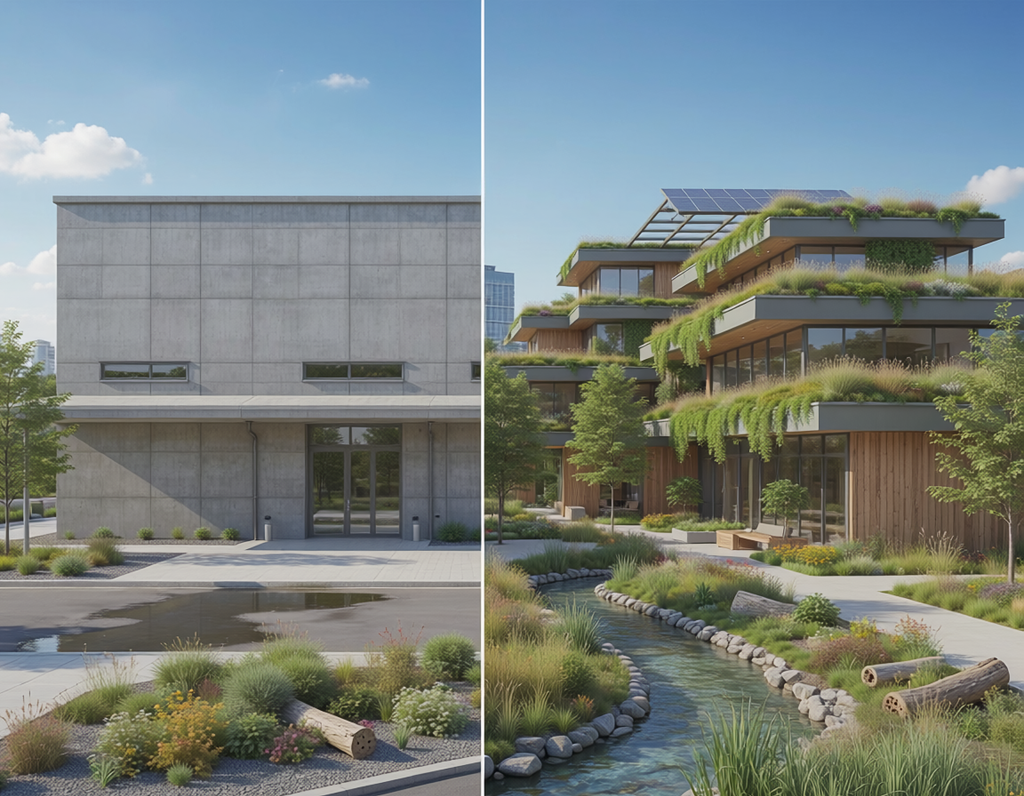
Redefining Competitiveness: Macro-Economic Resilience and Natural Capital in the Built Environment
Within modern real estate development, urban design, and environmental economics, competitiveness has undergone a profound conceptual shift. Historically, public and commercial discourse framed economic edge in terms of short-term financial performance, rapid construction cycles, and the minimization of upfront regulatory costs (Oppla, 2017). However, within contemporary ecosystemic research and built environment frameworks, true territorial and corporate competitiveness is recognized as an integrated metric. It directly couples regional economic output with social welfare, public health, and long-term natural capital preservation (A-Track, 2025).
[Traditional Corporate Frame] ──► [Short-term CapEx Focus] ──► High Climate Vulnerability
│
▼ (Market Shift)
[Nature-Positive Framework] ──► [Value-Driven Eco-Assets] ──► Lasting Structural Premium
Methodological Frameworks and Environmental Assets
Evaluating and scaling the commercial viability of structural assets in dense urban zones requires moving beyond traditional cost-accounting metrics. Because climate-induced disruptions—such as intense flash floods and severe heat waves—pose direct financial threats to physical real estate, modern developers treat nature as an active economic asset rather than an optional landscape extra (Ecologic Institute, 2025). To measure this baseline protection, researchers apply a multi-tiered economic framework:
- Micro-Level Premium: The direct increase in real estate valuation, tenant retention, and energy cost-reductions achieved by integrating features like high-performance green walls or permeable pavements.
- Meso-Level Avoided Costs: The quantifiable reduction in municipal infrastructure damages and emergency management spending driven by distributed Nature-Based Solutions (NBS) (MDPI, 2026).
- Macro-Level Market Edge: The capacity of a region or enterprise to attract premier green financing, ensure supply chain stability, and comply smoothly with emerging international environmental regulations.
To operationalize these values, practitioners deploy advanced natural capital accounting and environmental footprinting methods. These techniques combine predictive biophysical modeling with asset risk evaluation. Using these integrated tools allows financial institutions to explicitly account for nature-based dependencies, moving away from vulnerable, resource-depleting construction practices and capturing a lasting market premium.
Overcoming Operational Bottlenecks via Joint Marketplaces
Despite the clear financial logic of nature-positive investing, translating sustainability metrics into everyday construction bidding and zoning laws faces significant institutional hurdles. These bottlenecks frequently stem from fragmented financial standards, a general lack of localized environmental data, and a historical disconnect between corporate risk analysts and ecological scientists (A-Track, 2025).
To bridge this data gap and standardize corporate reporting, the European planning and scientific community relies on dedicated knowledge networks like Oppla.eu. Operating as a joint science-policy marketplace for natural solutions, Oppla provides access to verified case studies, scalable toolkits, and standardized roadmaps developed by collaborative networks like the Go Nature Positive initiative. Using these shared platforms allows corporate and public actors to acquire tested business models, find investment-ready project designs, and deploy natural solutions that actively de-risk urban infrastructure.
Securing Long-Term Resiliency
Systematically embedding natural capital metrics into early project lifecycles shifts urban development from an extractive approach to a highly innovative, resilient paradigm. Recognizing that long-term commercial survival is fundamentally tied to ecosystem health allows forward-thinking organizations to transform nature from a regulatory cost into a primary vehicle for market innovation. Supported by open-access knowledge networks, this value-driven approach ensures that upcoming real estate investments consistently mitigate systemic climate liabilities, optimize public safety, and secure lasting territorial competitiveness.
References
- OpenNESS Project. (2017). Competitiveness: Understanding how sustainable management of ecosystem services and natural capital relates to EU competitiveness (Synthesis Paper No. 11). Oppla Repository Framework. https://oppla.eu/sites/default/files/old_files/uploads/sp-competitiveness.pdf
- Cited by: 48
- Go Nature Positive (GoNP!) / Ecologic Institute. (2025). Nature-Based Solutions as Enablers of a Nature-Positive Future in the Built Environment. European Policy Brief Series. https://www.ecologic.eu/20209
- Cited by: 16
- A-Track Project. (2025). Strengthening Europe’s competitiveness and resilience: Enabling reporting and disclosure on nature and better decision-making. Horizon Europe Innovation Brief. https://oppla.eu/a-track/resource/strengthening-europe%E2%80%99s-competitiveness-and-resilience%3A-enabling-reporting-and-disclosure-on-nature-and-better-decision-making
- Cited by: 22
- MDPI Infrastructure Transitions. (2026). Infrastructure Transitions Through Nature-Based Solutions: Aligning Perceptions and Economic Appraisals. Materials and Structures Research. https://www.mdpi.com/2412-3811/11/3/102
- Cited by: 8
Competitiveness
Relevant Contextual Keywords: Green economy, sustainable innovation, talent retention, liveability index, green investment attraction, circular economic advantage, smart city efficiency, high-performance districts, economic resilience, urban branding.
- A Strategy for Attracting Green Capital Investment: Positions municipalities to secure global funding for clean technology, bio-based design, and sustainable real estate.
- An Indicator of High Urban Liveability: Drives long-term economic attraction by offering clean air, abundant green space, efficient public transit, and spatial safety.
- A Catalyst for Circular Economic Innovation: Encourages local businesses to adopt repair networks, material sharing, and zero-waste manufacturing models.
- A Mechanism for Fostering Clean-Tech Innovation: Establishes green business incubators, research labs, and sustainable building demonstrator sites in urban cores.
- A Pillar of Energy and Resource Independence: Reduces municipal vulnerability to global energy price spikes by building decentralized, localized renewable microgrids.
- A Tool for Talent Attraction and Retention: Draws highly skilled workers and young professionals by cultivating sustainable, biophilic, and culturally vibrant streetscapes.
- A Strategic Enabler of Efficient Municipal Operations: Lowers city operating costs through smart utility grids, automated waste management, and passive infrastructure.
- A Benchmark for Global Sustainability Rankings: Measures city economic output relative to its environmental footprint, circularity metrics, and carbon intensity.
- A Driver for High-Performance Real Estate Markets: Elevates property values and lease rates for energy-efficient, net-zero-certified architectural designs.
- A Foundation for Long-Term Economic Resilience: Protects cities from economic obsolescence by proactively adapting physical assets to future regulatory and climate constraints.