Climate Resilience in the Built Environment: Ecosystemic Methods and Knowledge Platforms
Climate resilience is the capacity of social, economic, and environmental systems to withstand, respond to, and recover from climate-related shocks and stressors. As extreme weather events increase in frequency and severity, fostering resilience has shifted from a forward-looking strategy to an immediate operational necessity. True systemic resilience requires moving past traditional, rigid engineered defenses that fail under unprecedented stresses. Instead, modern frameworks emphasize flexible, adaptive planning that treats physical infrastructure and natural ecosystems as interconnected assets. By embedding natural processes directly into systemic planning, communities can safeguard vulnerable populations, maintain critical services, and dynamically adapt to a changing environment.

Abstract
Traditional, rigid engineered infrastructure is increasingly vulnerable to the intensifying effects of climate change. In response, a paradigm shift is underway toward integrating Nature-based Solutions (NbS) into spatial planning and the built environment. This article evaluates how ecosystemic research, green-blue infrastructure, and open-source knowledge repositories like Oppla.eu advance urban climate resilience. By shifting from reactive defense structures to multifunctional ecological design, cities can simultaneously mitigate urban heat, manage extreme stormwater events, and enhance biodiversity.
Introduction: Redefining Infrastructure
For decades, urban development relied on “grey infrastructure”—inflexible concrete networks designed to repel environmental hazards. However, the accelerating pace of climate change renders these static systems highly vulnerable to unprecedented failure (Cook, 2025). Climate resilience within the built environment demands a fundamental structural evolution (Corgo et al., 2024).
Modern spatial planning increasingly adopts an ecosystemic approach, framing the built environment not as an isolated human enclave, but as an open system deeply intertwined with natural ecological processes (Sommese, 2024). Central to this evolution is the deployment of Nature-based Solutions (NbS)—actions that protect, sustainably manage, and restore ecosystems to address societal challenges effectively and adaptively (Oliver et al., 2021).
Ecosystemic Methods and the Taxonomy of the Built Environment
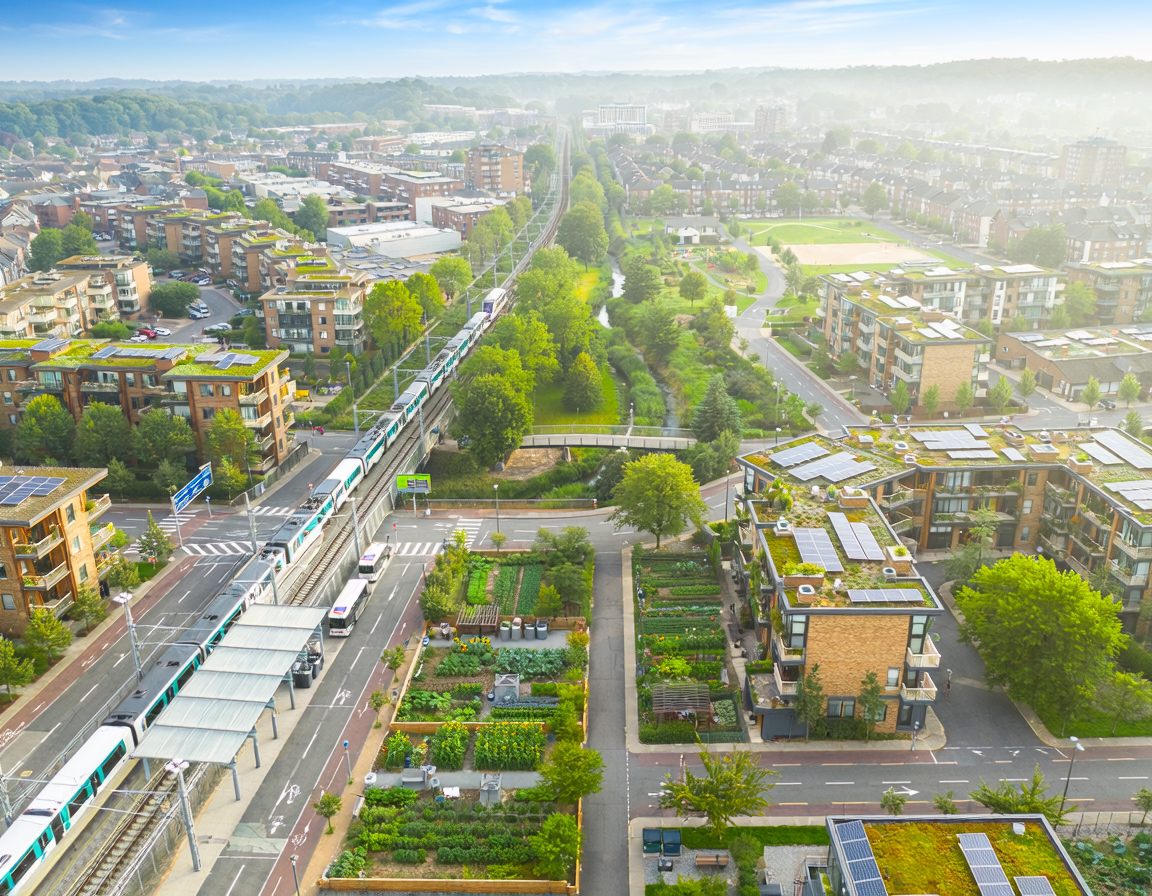
Ecosystemic research focuses on leveraging natural ecological functions to replace or augment civil engineering. Within the built environment, this methodology operates across two distinct physical scales to provide essential ecosystem services (Sommese, 2024):
- The Building Scale: Integrating vegetation directly into architectural design via extensive green roofs and living walls. These installations act as thermal buffers, drastically lowering structural energy demands and mitigating localized microclimatic heat (Anderson & Gough, 2022).
- The Urban Scale: Implementing interconnected green-blue infrastructure, including bioswales, rain gardens, permeable pavements, and constructed urban wetlands (Castelo et al., 2023).
These methods target the two main climate vulnerabilities of dense metropolitan areas: the Urban Heat Island (UHI) effect and catastrophic pluvial flooding (Anderson & Gough, 2022). Unlike concrete culverts that rapidly channel stormwater into over-burdened aquatic systems, urban nature preserves natural hydrology by absorbing, storing, and slowly infiltrating precipitation back into the ground (Castelo et al., 2023). Furthermore, these distributed networks offer critical secondary assets, such as air filtration, enhanced public health, and localized biodiversity corridors (Cook, 2025).
The Role of Knowledge Sharing Platforms: Oppla.eu
Scaling up nature-based frameworks from isolated pilot projects to regional planning policies presents notable governance and technical challenges. Planners frequently operate under significant uncertainty regarding the long-term performance, economic trade-offs, and ecological success of hybrid systems (Cook, 2025).
To resolve these information bottlenecks, international networks have established centralized knowledge repositories. Platforms like Oppla.eu—the European Union’s repository for nature-based solutions—serve as critical collaborative ecosystems (O’Hogain & McCarton, 2018). Oppla connects researchers, municipal authorities, and practitioners, providing an open-access marketplace for case studies, performance indicators, and software toolkits. By tracking real-world successes and failures, these networks allow cities to crowdsource empirical data, de-risking public investments and accelerating the global operationalization of resilient urban spaces.
Metrics and Future Directions
A key remaining barrier in ecosystemic engineering is the lack of standardized, global frameworks to quantify the long-term effectiveness of nature-based infrastructure (Horneman, 2026). Ongoing ecosystemic research focuses heavily on developing robust environmental impact indicators (Horneman, 2026). As climate extremes become more severe, coupling localized empirical testing with regional digital twins will allow policymakers to systematically design the adaptive, circular, and highly resilient cities of the future (Bona et al., 2022).
References
Anderson, V., & Gough, W. A. (2022). Enabling nature-based solutions to build back better—An environmental regulatory impact analysis of green infrastructure in Ontario, Canada. Buildings, 12(1), 61. https://doi.org/10.3390/buildings12010061
Cited by: 42
Bona, S., Silva-Afonso, A., Gomes, R., Matos, R., & Rodrigues, F. (2022). Nature-based solutions in urban areas: A European analysis. Applied Sciences, 13(1), 168. https://doi.org/10.3390/app13010168
Cited by: 97
Castelo, S., Amado, M., & Ferreira, F. (2023). Challenges and opportunities in the use of nature-based solutions for urban adaptation. Sustainability, 15(9), 7243. https://doi.org/10.3390/su15097243
Cited by: 102
Cook, E. M. (2025). Nature-based solutions for urban sustainability. Proceedings of the National Academy of Sciences.
Cited by: 26
Corgo, J., Cruz, S. S., & Conceição, P. (2024). Nature-based solutions in spatial planning and policies for climate change adaptation: A literature review. Ambio, 53, 1599-1617. https://doi.org/10.1007/s13280-024-02052-1
Cited by: 37
Horneman, F. (2026). Exploring nature-based solutions’ effectiveness indicators for climate change adaptation: A systematic review. Frontiers in Environmental Science.
Cited by: 3
O’Hogain, S., & McCarton, L. (2018). Nature-based solutions. A Technology Portfolio of Nature Based Solutions, 1-9. Springer International Publishing. https://doi.org/10.1007/978-3-319-73281-7_1
Cited by: 180
Oliver, E., Ozment, S., Grunwaldt, A., Silva Paredes, M., & Watson, G. (2021). Nature-based solutions in Latin America and the Caribbean: Support from the Inter-American Development Bank. Inter-American Development Bank. https://doi.org/10.18235/0003689
Cited by: 14
Sommese, F. (2024). Nature-based solutions to enhance urban resilience in the climate change and post-pandemic era: A taxonomy for the built environment. Buildings, 14(7), 2190. https://doi.org/10.3390/buildings14072190
Cited by: 50