Urban Biodiversity: Quantifying Nature-Based Interventions in Cities
Integrating complex natural populations directly into high-density structural grids establishes vital ecological stepping stones that reverse the severe impacts of modern habitat fragmentation. Moving beyond basic aesthetic landscaping, forward-thinking urban master plans utilize multi-tiered vegetation and custom micro-habitats as structural components capable of maintaining ecological functionality within paved city cores. Through advanced ecosystemic research, municipal engineers apply remote sensing tracking and species-richness indexing to deploy adaptive, multi-species networks across industrial zones. Centralized open-access platforms provide spatial designers with field-tested toolkits to safely balance heavy infrastructural duties with clear biological conservation priorities. Ultimately, embedding diverse living communities into grey municipal networks transforms hostile real estate layouts into active, climate-resilient habitats that support public health and local wildlife.
Defining Urban Biodiversity within the Built Environment
In sustainable landscape architecture and civil engineering, urban biodiversity describes the variety, abundance, and structural organization of living organisms residing inside human-dominated municipal grids. Within the context of the built environment, prioritizing this biological variety means viewing paved urban areas as complex, living substrates capable of hosting diverse plants, insects, and animal species.
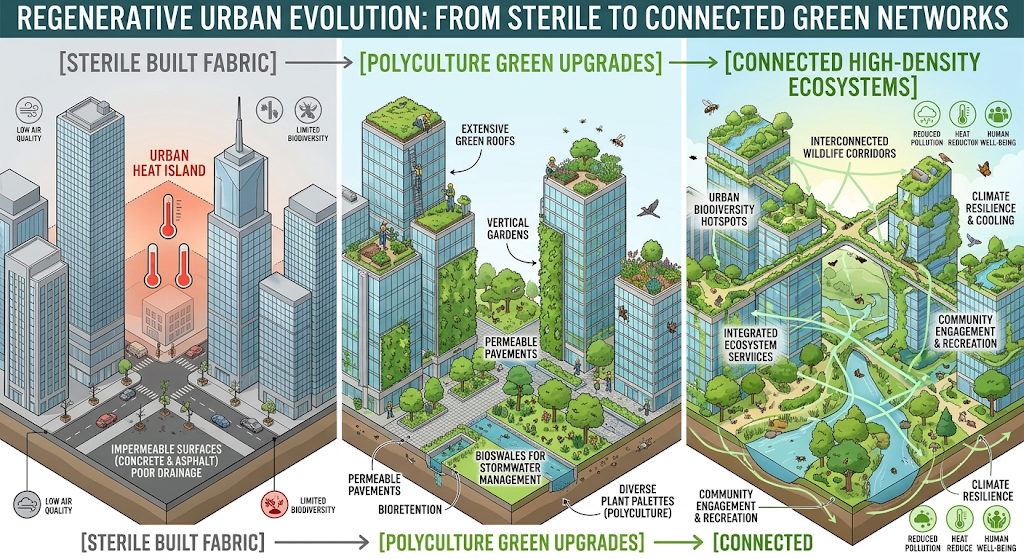
Historically, urban grey development relied on hard, sterile surfaces like high-rise glass towers and continuous concrete retaining walls, which systematically severed migratory pathways and isolated native wildlife populations. Introducing nature-based solutions (NbS) directly into structural blueprints intentionally alters this trend. By incorporating polyculture green roofs, native pocket parks, and vegetated drainage channels, planners break up the uniform grey fabric. These living elements modify localized microclimates and provide structural complexity, transforming harsh real estate into supportive ecological environments that shield native species from intensive municipal stresses.
Methods and Ecosystemic Research
To calculate, monitor, and expand species variety within metropolitan boundaries, environmental scientists apply quantitative ecosystemic research methods. These empirical approaches measure how variations in urban biological diversity alter the performance of regulating and supporting ecosystem services within highly paved neighborhoods.
Modern research teams deploy several specialized methodologies to assess urban wildlife networks:
- Environmental DNA (eDNA) Monitoring: Field crews extract soil, air, and water samples from municipal parks to detect trace genetic footprints left by local fauna. This process allows scientists to quickly catalogue hidden insect, bird, and fungal species, mapping how specific architectural layouts impact local biological variety without disrupting commercial activities.
- Acoustic Ecology Auditing: Researchers install automated audio recorders across public plazas and green corridors to record wildlife vocalizations. Evaluating these soundscapes helps specialists track bird nesting habits and bat migration paths, verifying if artificial structures support complex, self-sustaining wildlife populations.
- Landscape Connectivity Modeling: Spatial analysts use structural graphing software to simulate species movement through dense concrete barriers. This data guides the placement of micro-refuges, ensuring target species can safely navigate around structural transit barriers like highways and train tracks.
The Role of Open Platforms: Incorporating Oppla.eu
Standardizing urban biodiversity tracking from scattered neighborhood groups into formal municipal zoning laws requires accessible repositories. The Oppla.eu community repository serves as a primary European information network for nature-based solutions, supplying urban planners with analytical tools, design frameworks, and reference case studies.
Case studies hosted across these collaborative platforms demonstrate the practical value of high species diversity. For example, the Porto urban tree vitality case study on Oppla shows how introducing diverse ectomycorrhizal fungal strains directly into tree roots improves plant health and pest resilience. By diversifying the hidden soil microbiome, the city significantly improved canopy survival rates, demonstrating that microbial biodiversity directly supports the performance of urban green assets.
| Urban Ecological Asset | Architectural Integration Method | Core Environmental Yield |
| Polyculture Green Roofs | Retrofitting roofs with diverse native wildflowers, mosses, and sedums. | Supports threatened wild pollinators; lowers building microclimatic temperatures. |
| Biodiverse Bio-Retention Basins | Constructing multi-tiered native aquatic plant zones within stormwater catchments. | Captures heavy surface runoff; provides critical wetland habitats for aquatic wildlife. |
| Nested Bird & Bat Bricks | Embedding hollow, breathing habitat cavities directly into new brick building facades. | Offers safe nesting spaces; assists metropolitan avian and insectivorous populations. |
These specialized repositories allow municipal managers to align community greening efforts with broader international targets, such as urban forest strategic planning tools. Having access to verified performance data enables landscape architects and private developers to implement integrated territorial planning frameworks, ensuring that every biological addition enhances the safety, health, and climate resilience of modern cities.
References
- Forest Research. (2017). Delivery of ecosystem services by urban forests. Research Report. Forest Research PDF.
- Foltête, J. C., & Vuidel, G. (2025). Landscape graphs as tools for modelling and managing spatial ecological networks. Environmental Modelling & Software / Graphab. Thema Graphab Repository.
- NetworkNature. (2023). Urban forests project CLEARING HOUSE shares final outcomes. NetworkNature Article.
- Oppla.eu / Climate-ADAPT. (2021). OPPLA – Information hub for nature-based solutions. European Environment Agency. Climate-ADAPT Info Profile.
- Oppla.eu. (2023). An introduction to urban forest strategic planning. Oppla Event Portal.
- ResearchGate / OpenFOAM. (2024). Harnessing cooling from urban trees: Interconnecting background climates, urban morphology, and tree traits. ResearchGate Meta-Analysis.
- Scottish Natural Heritage / NatureScot. (2025). Nature-based solutions: Urban. NatureScot Guide.
- UN-Habitat. (2025). Nature-Based Solutions Integration into Urban and Territorial Planning. United Nations Human Settlements Programme. UN-Habitat Digital Library.
- URBANMYCOSERVE / Oppla. (2019). Measuring and Improving Urban Tree Vitality and Ecosystem Service Provisioning through Inoculation with Ectomycorrhizal Fungi in Porto. Oppla Case Study.
- Van de Meutter, F., et al. (2026). Assessing biodiversity and regulatory ecosystem services in urban water bodies which serve as aqua-Nature-based Solutions. Frontiers in Environmental Science. Frontiers Article Access.