Global material extraction has more than tripled since 1970, reaching over 100 billion tonnes annually. This linear trajectory—characterized by raw material extraction, transformation, short-life utilization, and eventual disposal—presents a fundamental macroeconomic friction. Environmental degradation, supply chain volatility, and carbon externalities are direct byproducts of a systemic failure to price raw material throughput accurately. Because natural resource extraction and sink capacities have historically been treated as unpriced or underpriced public goods, markets fail to reflect the true social marginal cost of resource depletion.
To resolve this market failure, modern resource governance relies on economic instruments designed to alter price signals across resource supply chains. Instruments such as material extraction taxes, virgin-resource levies, eco-modulated tariffs, and circular material quotas adjust price vectors to bridge the gap between private operational expenditures and total societal cost. By internalizing ecological costs directly into upfront capital and operational models, these policy mechanisms incentivize market actors to optimize raw material throughput, substitute recycled inputs for virgin stocks, and re-engineer production processes.
Realigning financial incentives with resource constraints transforms material efficiency from an explicit regulatory compliance cost into a core strategic driver of balance-sheet performance. When virgin inputs bear their true Pigovian cost, capital flows toward circular material loops, life-cycle extending design, and secondary market supply chains. Consequently, resource productivity increases, decoupling GDP growth from absolute material consumption.
1. Defining Resource Decoupling and Market Mechanics
Decoupling resource consumption refers to severing the historical link between economic expansion and primary material throughput. Unlike legacy command-and-control mandates—which enforce static technology standards or hard output caps—economic resource governance leverages price mechanisms to dynamically incentivize material conservation, recycling, and substitution.
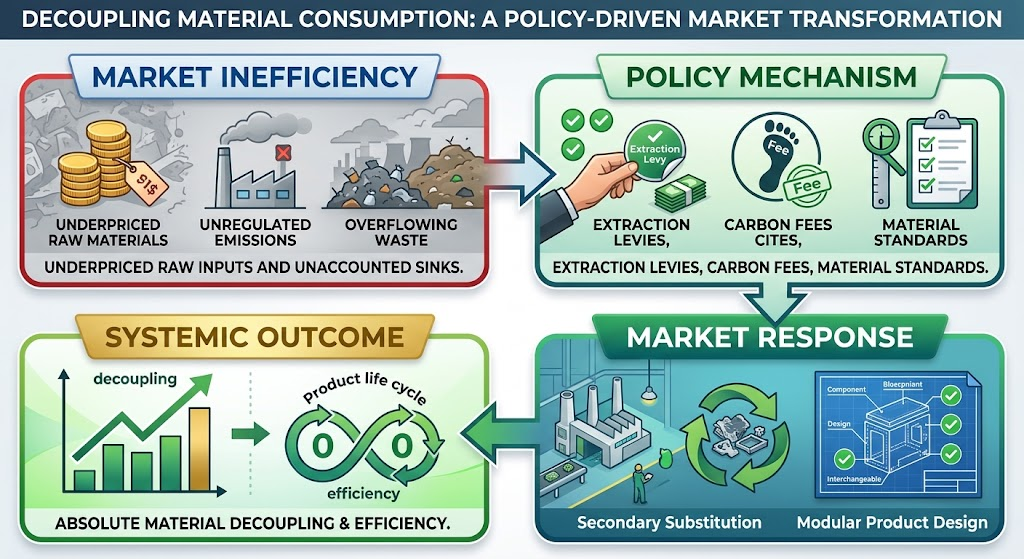
Primary Operational Channels
- Price Vector Adjustment: Imposing resource taxes or virgin material levies immediately raises the marginal cost of raw throughput relative to secondary alternatives. This shift penalizes resource-intensive inputs and creates a competitive margin for recovered, recycled, and renewable inputs.
- Abatement Cost Flexibility: Market-based resource policies grant industrial firms full flexibility regarding compliance path. Rather than dictating identical technical standards across diverse manufacturing sectors, firms with lower material substitution costs achieve higher conservation targets, reducing total economic compliance costs.
- Continuous Dynamic Innovation: Fixed administrative standards stop incentivizing innovation once a compliance threshold is met. Dynamic economic instruments maintain a continuous marginal financial benefit for every unit of virgin material conserved, driving sustained R&D investments in low-impact material science and advanced circular manufacturing processes.
Institutional monitoring and global tracking tools—such as the OECD Environment Statistics Database, the UNEP Global Material Flows Database, and the European Commission’s Circular Economy Indicators—provide standardized data infrastructure to evaluate national resource productivity ($GDP / domestic\ material\ consumption$) and monitor decoupling trajectories.
2. Comparative Policy Framework Analysis
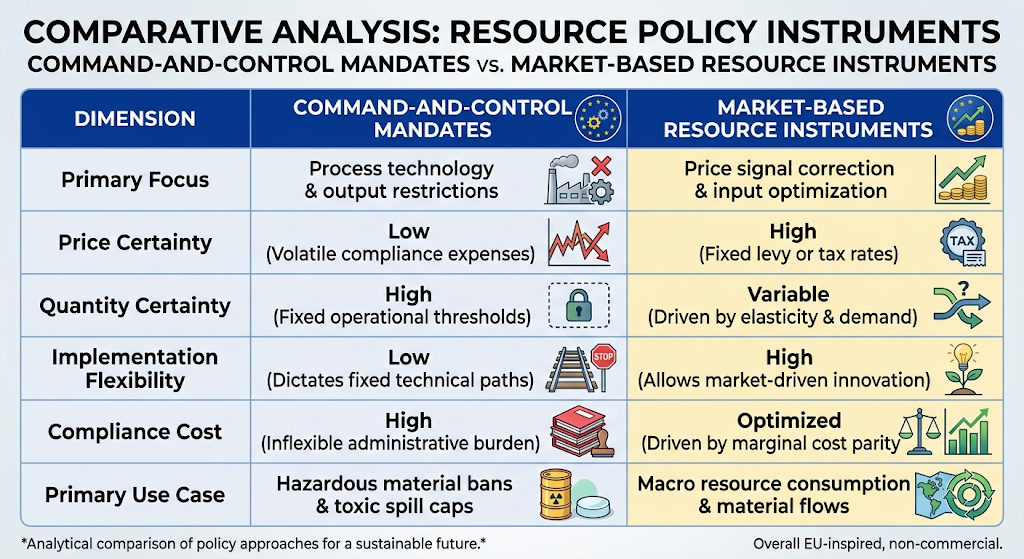
Abatement Efficiency and Information Asymmetry
Centrally planned material restrictions suffer from severe information asymmetry: regulators cannot accurately assess the specific marginal abatement cost (MAC) curve for every individual industrial facility. Imposing uniform technology standards forces high-cost abate facilities to incur disproportionate economic losses, elevating overall macroeconomic compliance expenditures.
Conversely, market-based mechanisms correct price signals while leaving operational decisions decentralized. Each market actor evaluates its internal marginal cost of material efficiency, secondary substitution, or re-engineering against the external price penalty. Firms reduce virgin material usage up to the precise point where their internal marginal abatement cost equals the prevailing resource tax rate ($MAC = Tax$). This market alignment minimizes the total net cost of achieving national material reduction targets.
3. Structural Taxonomy of Resource Governance Models
Resource consumption governance strategies divide into distinct price-based, quantity-based, and hybrid structural frameworks.
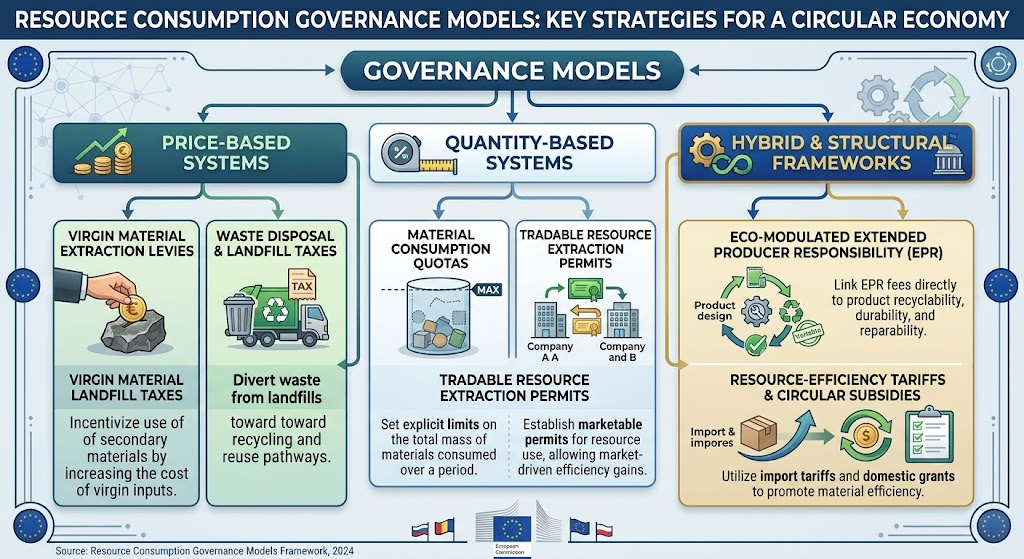
1. Price-Based Systems
Price-based models explicitly set the cost of virgin resource consumption, leaving aggregate volume to adjust according to market elasticity.
- Mechanics: Direct tax rates are applied per unit mass ($tonne$) of primary resource extracted (e.g., aggregates, minerals, timber) or waste generated. By increasing the base price of primary extraction, the net price differential between primary resources and secondary recovered inputs closes.
- Implementation Example: The United Kingdom Aggregates Levy applies a flat tax per tonne on commercially exploited sand, gravel, and crushed rock, directly incentivizing the use of recycled construction materials and demolition waste.
2. Quantity-Based Systems
Quantity-based frameworks establish strict upper caps on material extraction or consumption across a designated region or economic sector, allowing the market to trade allocation rights.
- Mechanics: Governing authorities set a maximum cap on total aggregate material throughput and distribute or auction corresponding extraction/consumption permits. Firms trade permits based on individual operational requirements, establishing a market-clearing price for resource consumption.
- Implementation Example: Catch Share Systems and tradable quota allocations in managed commercial fisheries limit total biomass extraction while enabling efficiency-driven market trading among license holders.
3. Hybrid and Eco-Modulated Frameworks
Hybrid architectures combine regulatory thresholds with variable fee adjustments to incentivize lifecycle product re-engineering.
- Mechanics: Fee structures scale based on life-cycle metrics, such as repairability scores, recycled content percentages, or material complexity. Products designed for rapid disassembly and high recyclability receive fee rebates (eco-concessions), while difficult-to-recycle multi-material designs incur steep financial surcharges (eco-penalties).
- Implementation Example: The European Union’s Revised Waste Framework Directive mandates eco-modulation under national Extended Producer Responsibility (EPR) schemes, penalizing electronics and packaging producers that rely on non-recyclable composite plastics.
4. Policy Challenges & Strategic Implementation
Resource governance models face significant systemic implementation barriers that require structured policy countermeasures.
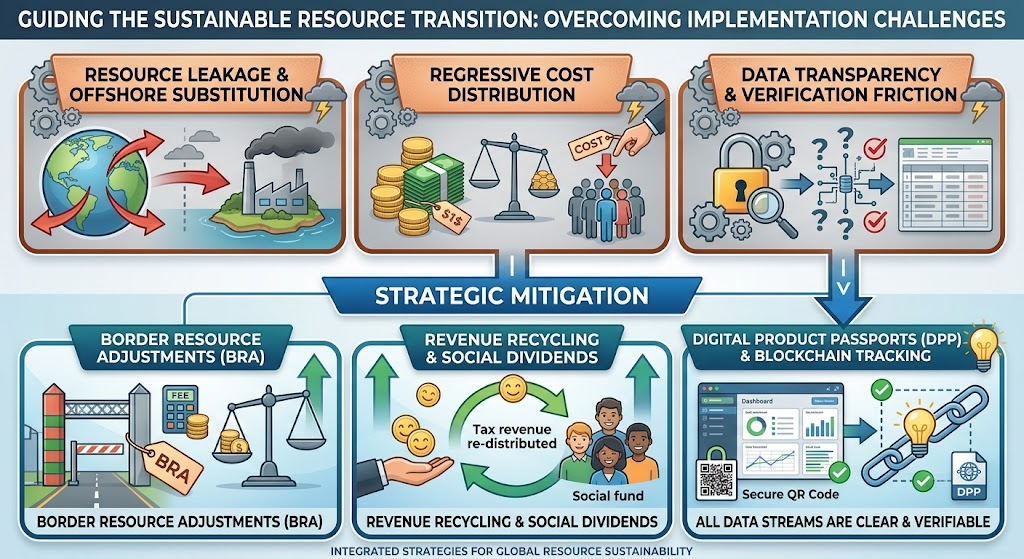
Headwinds and Strategic Solutions
- Resource Leakage and Offshore Substitution: High domestic resource levies can incentivize manufacturing firms to offshore resource-intensive processing to jurisdictions with lower environmental standards, resulting in zero net reduction in global material consumption (resource leakage).
- Mitigation Solution: Implement Border Resource Adjustments (BRAs) that apply equivalent material charges on imported resource-intensive finished products, equalizing market conditions between domestic producers and foreign exporters.
- Regressive Cost Distribution: Inelastic demand for essential primary goods (such as building materials or baseline energy inputs) can transfer resource tax burdens directly to end consumers, disproportionately affecting lower-income socio-economic groups.
- Mitigation Solution: Establish targeted revenue recycling frameworks where tax receipts fund lump-sum social dividends, direct low-income subsidies, or capital grants for residential energy and circular material retrofits.
- Data Transparency and Verification Friction: Accurately calculating life-cycle secondary material content and tracking complex cross-border supply chains creates administrative overhead and exposes systems to fraud.
- Mitigation Solution: Mandate standardized digital infrastructure, such as Digital Product Passports (DPPs) deployed on distributed ledger networks, to provide immutable verification of material origin, compositional purity, and repair history.
5. Systemic Transformation and Macroeconomic Transition
Internalizing the societal costs of resource consumption shifts industrial strategy from linear throughput optimization to resource velocity and circular efficiency. Historically, business models relied on high-volume production supported by cheap primary inputs and unpriced end-of-life disposal. Integrating material levies and eco-modulated instruments makes raw resource intensity a core balance-sheet liability.
In response, capital shifts toward resource-efficient infrastructure, advanced chemical and mechanical recycling, asset-as-a-service models, and modular architecture. Industrial ecosystems shift toward circular material loops where secondary stocks maintain high functional utility across multiple product life cycles. Economic growth transitions away from physical material extraction, aligning private profitability with long-term ecological balance and resource security.
6. References & Institutional Resources
- European Commission. (2020). Circular Economy Action Plan: For a cleaner and more competitive Europe. European Union Policy Framework
- International Resource Panel (IRP). (2019). Global Resources Outlook 2019: Natural Resources for the Future We Want. United Nations Environment Programme
- OECD. (2018). Global Material Resources Outlook to 2060: Economic Drivers and Environmental Consequences. OECD Publishing
- Pigou, A. C. (1920). The Economics of Welfare. Macmillan and Co. Library of Economics and Liberty
- World Bank. (2022). Squaring the Circle: Policies from Europe and Central Asia for a Sustainable Resource Transition. World Bank Publications
7. Strategic Classifications and Key Takeaways
Core Domain Keywords
- Material Decoupling
- Pigovian Resource Extraction Levy
- Marginal Abatement Cost (MAC)
- Eco-Modulated Extended Producer Responsibility (EPR)
- Digital Product Passport (DPP)
High-Level Strategic Takeaways
- Price Correction Underpins Resource Conservation: Underpriced virgin inputs cause systemic overconsumption; correcting price signals via extraction levies is a prerequisite for circular market realignment.
- Static Standards Increase Compliance Overhead: Direct command-and-control mandates ignore industry-specific cost variations, driving up national abatement costs compared to flexible economic instruments.
- Dynamic Incentives Fuel Material Innovation: Continuous price signals incentivize ongoing R&D in secondary substitution and modular assembly beyond arbitrary minimum targets.
- Decoupling Secures Long-Term Value Creation: Increasing material productivity breaks the dependency between real GDP expansion and raw throughput, mitigating supply chain exposure.
- Information Asymmetry Favors Market Mechanisms: Decentralized markets allocate conservation tasks to actors with the lowest marginal abatement costs far more efficiently than central regulators.
- Eco-Modulation Targets Upstream Design: Scaling producer fees based on product repairability and recyclability forces circular considerations directly into the early design phase.
- Border Adjustments Prevent Regulatory Arbitrage: Border Resource Adjustments preserve industrial competitiveness while preventing domestic policy leakage to low-regulation jurisdictions.
- Revenue Recycling Neutralizes Regressive Impacts: Directing resource tax receipts into social dividends or green capital investments offsets cost impacts on lower-income populations.
- Digital Passports Provide Verifiable Traceability: Standardized digital records ensure transparent compliance verification for secondary material claims across complex international supply chains.
- Resource Efficiency Reallocates Global Capital: Systematically penalizing linear throughput drives capital deployment into asset-as-a-service models, secondary resource infrastructure, and closed-loop material networks.