
The systemic risk of global warming stems from a structural failure of market dynamics: the unpriced negative externality of anthropogenic greenhouse gas (GHG) emissions. For over two centuries, industrial economic models have permitted commercial entities to emit carbon dioxide (CO2) and other radiatively active trace gases into the global atmospheric commons at zero direct cost. This market omission creates a rift between private marginal costs and social marginal costs, misallocating capital toward carbon-intensive infrastructure while transferring the mounting costs of environmental degradation, climate volatility, and natural capital depletion onto global society.
To address this systemic failure, climate governance relies on internalizing these environmental costs directly into corporate financial statements. By instituting explicit or implicit carbon pricing, policymakers transform atmospheric capacity from an unpriced common-pool resource into a finite, economically valued commodity. This operational shift forces market participants to integrate the social cost of carbon into everyday capital expenditure (CapEx) planning, operational expenditure (OpEx) strategies, and long-term asset valuation models.
Establishing a clear cost for emissions realigns private financial incentives with global decarbonization goals. Rather than relying on static administrative mandates, market-based carbon instruments exploit competitive market dynamics to identify the lowest-cost abatement options across diverse industrial sectors. By establishing a persistent economic signal, carbon pricing mobilizes private capital toward low-carbon research, development, and deployment, converting environmental compliance from a regulatory burden into a metric of economic competitiveness.
1. Definition and Economic Mechanics of Carbon Pricing
Carbon pricing is an environmental policy instrument that assigns a direct financial cost to the emission of greenhouse gases, measured in units of carbon dioxide equivalent (CO2e). Unlike traditional command-and-control regulatory mandates—which prescribe specific technological installations or uniform emission limits—carbon pricing establishes a continuous financial incentive to reduce emissions while granting regulated entities full operational autonomy over their specific compliance pathways.
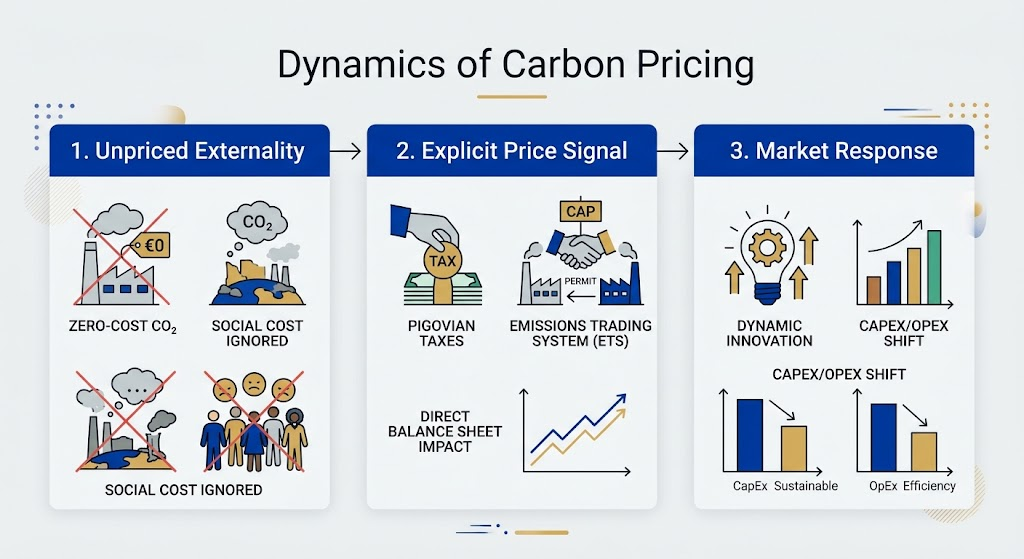
The mechanism operates through three fundamental channels:
- Price Vector Adjustment: By embedding the marginal social cost of greenhouse gas emissions directly into the relative prices of fuels, industrial inputs, and end-consumer products, carbon pricing tilts market demand away from carbon-intensive goods toward cleaner alternatives without requiring central planning decisions.
- Abatement Cost Flexibility: Marginal abatement cost curves (MACCs) vary significantly across industrial sectors and individual firms. Carbon pricing enables entities facing high abatement costs to purchase allowances or pay taxes, while enabling low-cost abatement entities to over-comply and monetize their reductions, minimizing the total macroeconomic cost of climate mitigation.
- Continuous Dynamic Innovation: Fixed technological mandates encourage firms to meet a minimum static threshold and stop. Explicit price signals create a perpetual incentive to innovate, encouraging continuous research into next-generation zero-emission technologies to lower recurring compliance expenditure.
Global institutions—such as the World Bank through its Carbon Pricing Dashboard, the OECD, and the European Commission—track these instruments globally. Canonical economic literature, originating from Arthur Pigou’s conceptualization of corrective taxation and Ronald Coase’s framework on property rights and transaction costs, provides the theoretical foundation for these active policy frameworks.
2. Comparative Analysis: Market-Based Instruments vs. Command-and-Control Regulations
Decarbonization policy tools fall broadly into two operational paradigms: Market-Based Instruments (MBIs), which rely on economic incentives, and Command-and-Control (CAC) regulations, which rely on rigid administrative prescriptions.
| Dimension | Market-Based Instruments (e.g., Taxes, Cap-and-Trade) | Command-and-Control (e.g., Performance Standards, Tech Mandates) |
| Primary Focus | Internalizing externalities via price or quantity controls | Direct physical compliance via mandates and technology standards |
| Price Certainty | High in price-based schemes (taxes); Variable in market schemes (ETS) | Low; compliance costs vary unpredictably across industrial actors |
| Quantity Certainty | Variable in price schemes; High in quantity schemes (fixed caps) | High for targeted point sources; Variable across macroeconomic sectors |
| Implementation Flexibility | High; firms determine optimal time, method, and depth of abatement | Low; mandates require uniform technology adoption across all regulated entities |
| Compliance Cost | Optimized; minimizes aggregate expenditure via MACC equalization | Sub-optimal; forces high-cost compliance regardless of efficiency |
| Primary Use Case | Broad economy-wide decarbonization, energy, and heavy industry | Targeted point-source toxicity control or urgent technical phase-outs |
Abatement Efficiency and Information Asymmetry
The economic superiority of market-based instruments in large-scale system interventions stems from the challenge of information asymmetry. Centralized regulatory agencies rarely possess full, real-time insight into the operational expenditure structures and marginal abatement costs of diverse private industrial facilities.
When regulators deploy uniform command-and-control mandates, they inevitably force some facilities to adopt abatement strategies at exorbitant marginal costs, while leaving lower-cost abatement opportunities unexploited elsewhere. MBIs resolve this information bottleneck by decentralizing compliance decisions. The price signal acts as an information vector, prompting individual market actors to execute abatement actions only when their private marginal abatement cost is less than or equal to the prevailing market carbon price (MACPcarbon).
3. Core Operational Models of Carbon Pricing
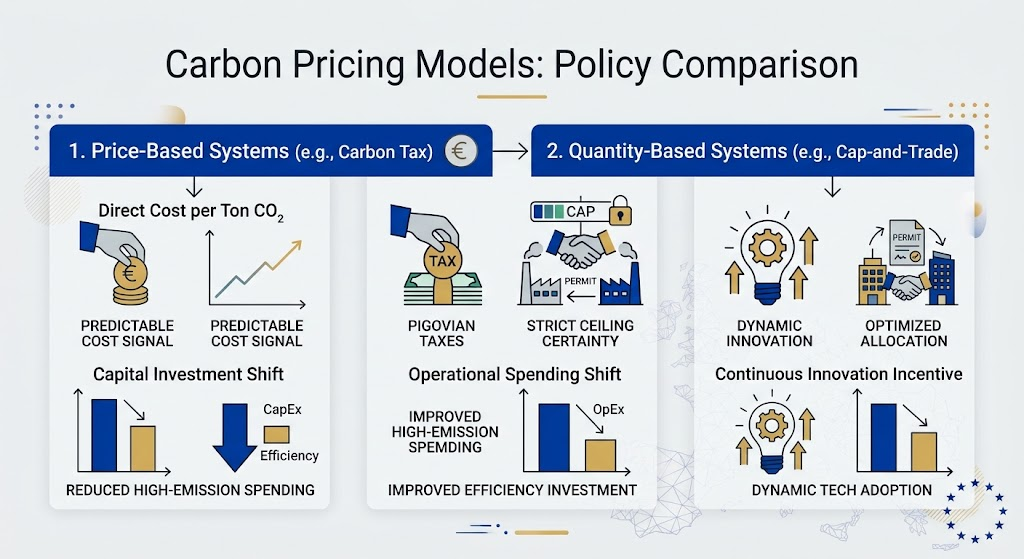
Price-Based Mechanisms: Carbon Taxation
Price-based frameworks fix the financial cost per unit of emissions via an explicit government surcharge. Regulated entities pay a predetermined levy for every metric ton of CO2e emitted into the atmosphere.
- Operational Mechanics: The tax rate acts as an administrative floor for the price of carbon. Firms compare their internal MACC against this tax rate: if mitigating a ton of carbon costs $30 and the tax rate is $50, the firm abates its emissions to optimize profits.
- Key Example: The British Columbia Carbon Tax illustrates this approach, taxing fuel combustion across residential, commercial, and industrial sectors with predictable, pre-announced rate increases to signal long-term investment priorities.
Quantity-Based Mechanisms: Emissions Trading Systems (ETS) / Cap-and-Trade
Quantity-based mechanisms set a strict cap on aggregate greenhouse gas emissions within a defined jurisdiction and issue a corresponding volume of tradable emission allowances.
- Operational Mechanics: Regulated firms must surrender one allowance for every ton of CO2e emitted over a compliance period. Allowances are distributed via state-managed auctions or targeted free allocations. Firms with excess allowances sell them on open carbon exchanges to entities facing allowance shortages, establishing a dynamic market-clearing price.
- Key Example: The European Union Emissions Trading System (EU ETS), launched in 2005, operates as a cap-and-trade system. It covers power generation, heavy manufacturing, and aviation, systematically decreasing the total allowance cap over time to meet target reduction milestones.
Valuation and Subsidy Interventions: Crediting and Contractual Mechanisms
To complement direct pricing, targeted financial interventions address specific market barriers in low-carbon technology deployment.
- Baseline-and-Credit / Offsets: Entities operating outside a capped sector generate verified carbon credits by executing projects that reduce, avoid, or sequester emissions below a baseline. Capped entities can then purchase these credits to fulfill a portion of their regulatory compliance obligations.
- Contracts for Difference (CfDs) & Feed-in Tariffs (FiTs): Governments use Carbon Contracts for Difference (CCfDs) to guarantee low-carbon industrial projects a fixed strike price for carbon reductions. If the market carbon price falls below the agreed strike price, the state pays the difference, mitigating regulatory uncertainty for early-stage capital investments.
4. Policy Challenges and Strategic Implementation
While economically efficient, deploying carbon pricing mechanisms presents complex geopolitical, structural, and social challenges that require careful policy design.
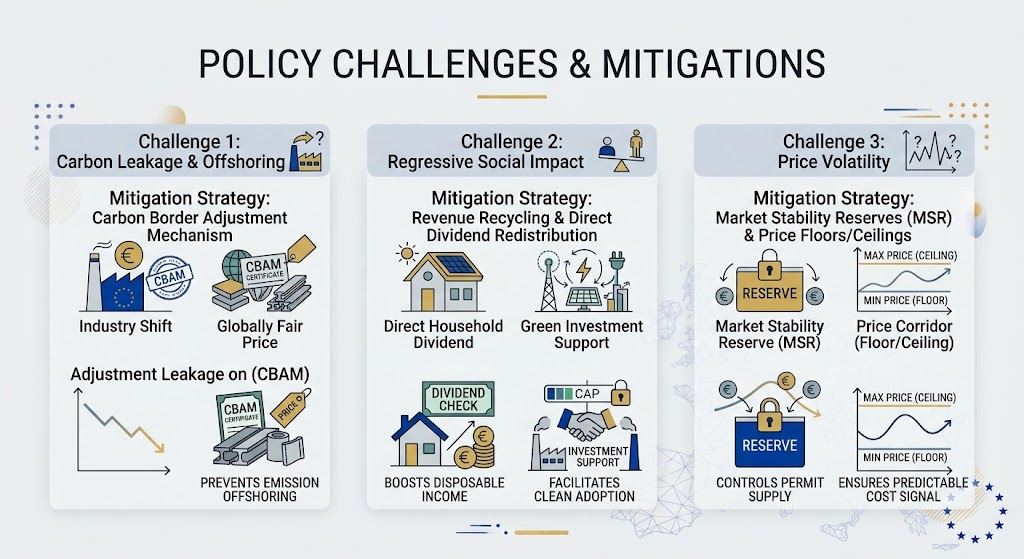
Carbon Leakage and Competitive Disadvantages
When a jurisdiction imposes a stringent carbon price, domestic industrial producers face elevated compliance costs relative to international competitors operating in unpriced regions. This disparity creates the risk of carbon leakage, where carbon-intensive production, employment, and investment relocate abroad, offsetting global emissions gains while damaging domestic economic activity.
- Strategic Mitigation: Governments traditionally issued free allowance allocations based on emissions benchmarks to vulnerable, trade-exposed industries. Modern governance is shifting toward border adjustment tariffs, such as the EU Carbon Border Adjustment Mechanism (CBAM), which levies an equivalent carbon fee on imported goods (e.g., steel, aluminum, cement) based on their embedded carbon content.
Regressive Social Impacts and Revenue Recycling
Because low-income households spend a larger share of their disposable income on energy, heating, and transportation, uniform carbon taxes on consumer fuels can operate regressively, triggering public opposition and socioeconomic instability.
- Strategic Mitigation: Effective policy implementation relies on revenue recycling. Carbon revenues can be returned to citizens via direct tax dividends (as demonstrated by Canada’s Climate Action Incentive Payments) or targeted income tax cuts. Alternatively, funds can be reinvested into public green infrastructure and clean-energy subsidies.
Market Volatility and Price Instability
Quantity-based schemes (Cap-and-Trade) often suffer from allowance price volatility driven by broader macroeconomic shocks, industrial shifts, or regulatory changes, which can undermine long-term CapEx planning for low-carbon investments.
- Strategic Mitigation: Modern ETS architectures integrate structural price management mechanisms, such as Market Stability Reserves (MSRs) that absorb excess market liquidity, alongside explicit price floors and allowance price containment reserves.
5. Conclusion
Establishing direct, market-based pricing mechanisms transforms atmospheric management from an unpriced social liability into an active factor of industrial production. By translating carbon abatement into a explicit metric of balance-sheet performance, carbon pricing forces corporate management, capital markets, and institutional investors to integrate climate risk directly into financial planning and operational strategy.
Ultimately, carbon pricing provides a structural framework that harmonizes macroeconomic policy with environmental targets. As expanding international networks, border adjustment mechanisms, and corporate carbon accounting standards align, carbon pricing serves as a primary driver of clean technology innovation, market realignment, and systemic global decarbonization.
References & Further Reading
- World Bank Group. (2024). State and Trends of Carbon Pricing 2024. World Bank Publications. https://openknowledge.worldbank.org/handle/10986/41512
- OECD. (2023). Effective Carbon Rates 2023: Pricing Greenhouse Gas Emissions Through Taxes and Emissions Trading. OECD Publishing. https://www.oecd.org/tax/tax-policy/effective-carbon-rates-2023.htm
- Nordhaus, W. D. (2015). Climate Clubs: Overcoming Free-Riding in International Climate Policy. American Economic Review, 105(4), 1339–1370. https://www.aeaweb.org/articles?id=10.1257/aer.15000001
- European Commission. (2023). EU Emissions Trading System (EU ETS) Handbook and CBAM Governance Framework. Directorate-General for Climate Action. https://ec.europa.eu/clima/policies/ets_en
- Stern, N. (2007). The Economics of Climate Change: The Stern Review. Cambridge University Press. https://www.cambridge.org/stern_review
Classifications & Key Takeaways
Keywords
- Carbon Pricing
- Market-Based Instruments
- Cap-and-Trade
- Pigovian Taxation
- Carbon Border Adjustment Mechanism (CBAM)
High-Level Strategic Takeaways
- Carbon pricing addresses a primary market failure by internalizing the negative externalities of $CO_2 e$ emissions directly into corporate financial statements.
- Price-based mechanisms (taxes) provide financial predictability, whereas quantity-based mechanisms (ETS) enforce precise emissions caps.
- Market-based systems overcome regulatory information asymmetry by enabling individual entities to optimize compliance according to their unique marginal abatement cost curves.
- Continuous dynamic price signals encourage ongoing research and development in zero-emission technologies beyond static compliance baselines.
- Carbon border adjustment mechanisms help mitigate carbon leakage and protect domestic competitiveness by placing equivalent fees on carbon-intensive imports.
- Revenue recycling models—such as climate dividends and targeted tax reductions—address the regressive social impacts of increased fuel and energy costs.
- Market Stability Reserves and price floors help reduce allowance volatility in cap-and-trade systems, providing clearer price signals for long-term CapEx planning.
- Carbon Contracts for Difference lower financial risks for early-stage low-carbon industrial projects by guaranteeing a predictable strike price for carbon reductions.
- Integrating explicit carbon pricing into corporate accounting drives institutional capital toward clean technologies, infrastructure, and sustainable supply chains.
- Aligning carbon pricing systems internationally accelerates global emissions abatement and minimizes trade frictions during the net-zero transition.