Fire within the context of the built environment has historically been approached through structural isolation and mechanical containment. However, contemporary ecosystemic research reframes fire as a dynamic ecological process requiring passive landscape architectural methods and systemic interventions. As residential development encroaches into highly vulnerable ecosystems, the traditional reliance on rigid, grey-infrastructure fire breaks is transitioning toward integrated nature-based solutions. By deploying strategically configured vegetative zones, close-to-nature forest management, and green firebreaks, urban planners can establish functional buffer zones that mitigate intense flame fronts. This holistic methodology balances urban civil protection with structural land stewardship, changing fire from a destructive threat into a managed natural element within human settlements.
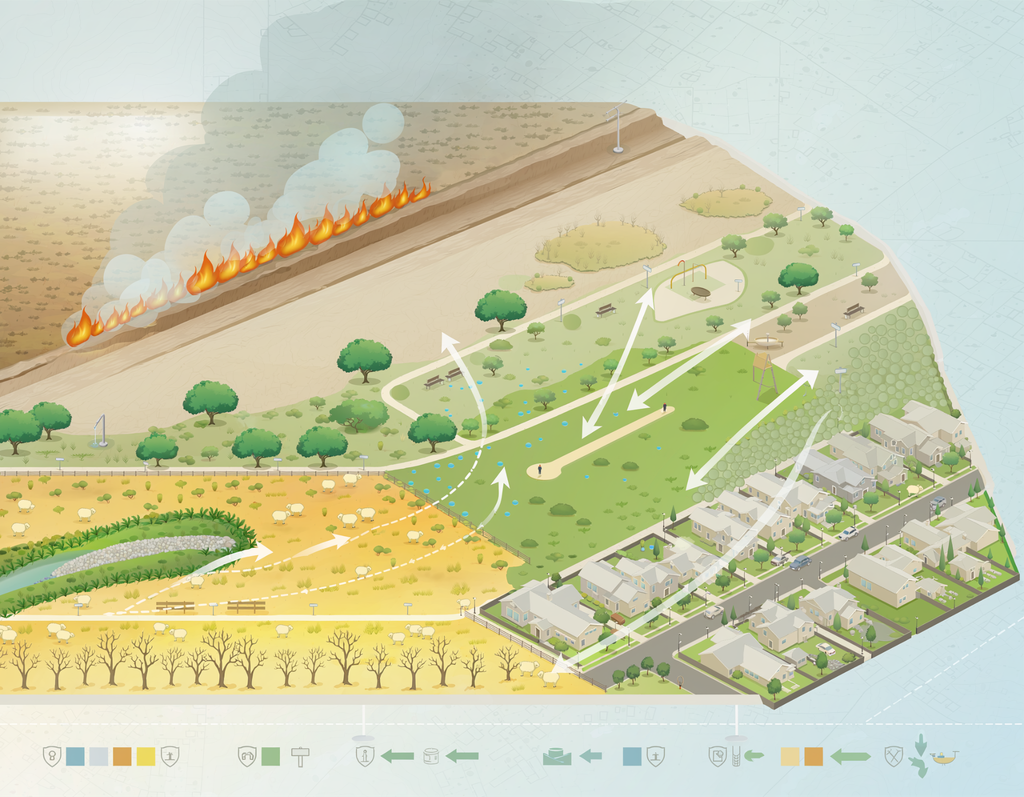
As rapid urbanization and changing climate conditions accelerate environmental disruptions, the intersection where human settlements meet undeveloped landscapes faces severe systemic threats. The phenomenon of wildfire risks in Europe and globally has intensified, forcing architectural, engineering, and regional planning disciplines to re-examine the role of fire. Historically, the built environment addressed fire through passive compartmentalization, strict building materials, and active suppression. Modern ecosystemic research, however, emphasizes shifting from artificial fire suppression toward systemic fire management by employing nature-based solutions (NBS) and strategic spatial design.
The Wildland-Urban Interface (WUI) Challenge
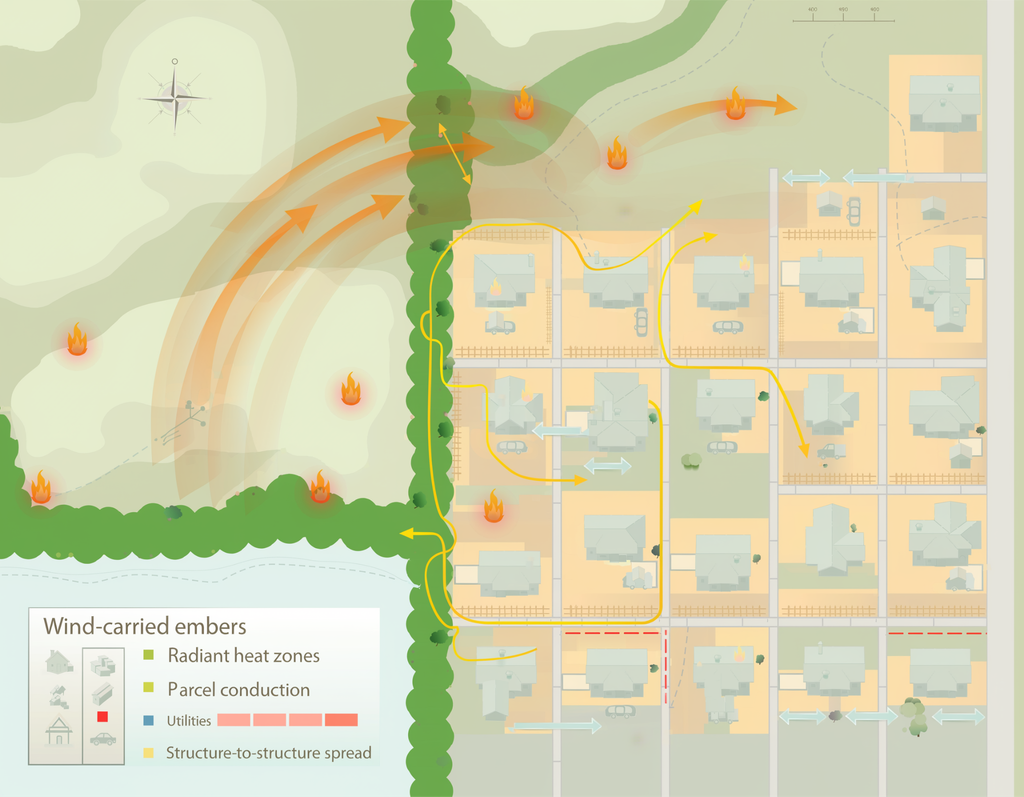
The primary geographic zone of vulnerability is the wildland-urban interface (WUI), where human structures directly intermingle with wildland vegetation and natural fuels. Expansion within these areas means that localized building density non-linearly accelerates wildfire exposure. Human presence acts as a major catalyst for ignition, while the close proximity of buildings provides structural fuel pathways that escalate small spot fires into catastrophic conflagrations.
┌──────────────────────────────────────────────────────────┐
│ WUI FIRE INTERACTION PATHWAYS │
├────────────────────────────┬─────────────────────────────┤
│ Fuel Source Typology │ Propagation Mechanism │
├────────────────────────────┼─────────────────────────────┤
│ • Wildland Vegetation │ • Wind-Carried Embers │
│ • Auxillary Fuels (Sheds) │ • Parcel-to-Parcel Conduction│
│ • Built Structures │ • Radiant Heat Flux │
└────────────────────────────┴─────────────────────────────┘
To break this cycle, architectural standards demand defensive zoning, such as maximizing structure-separation distances and covering attic vents with fine mesh to catch embers. However, mitigating structural damage requires looking past the individual building envelope to consider macro-level landscape configuration and spatial planning.
Landscape-Scale Methods and Nature-Based Solutions
Ecosystemic research focuses on managing the continuous fuel sources that allow wildfires to breach urban boundaries. By utilizing the nature-based solution frameworks aggregated on platforms like Oppla.eu, planners can design landscapes that actively hinder fire propagation. Rather than clearing all natural vegetation, which triggers habitat fragmentation and erosion, structural land stewardship integrates green firebreaks and buffer zones composed of low-flammability, native broadleaved species.
[ Wildland Fuel Load ]
│
▼
[ Buffer Zone: Low-Flammability Crops ]
│
▼
[ Green Firebreak: Broadleaved Trees ]
│
▼
[ Defensible Space: 30ft ]
│
▼
[ Hardened Built Structure ]
These strategically placed natural barriers slow down flame advancement, suppress radiant heat, and filter out wind-blown embers. Collaborations within the Firelogue wildfire management network highlight that close-to-nature forest management—incorporating controlled grazing, agroforestry, and deadwood reductions—reduces regional fuel accumulation. This approach protects surrounding property while maintaining biodiversity and nutrient cycling.
Integrating Co-Governance and Structural Design
Transitioning to an integrated fire management paradigm requires deep coordination between civil protection, ecological scientists, and local communities. Municipalities can access the Climate-ADAPT knowledge hub to find verified case studies that align local building regulations with nature-based regional planning. Designing a resilient built environment involves pairing directional wall hardening with community-wide green infrastructure. This balanced framework ensures that when a fire event occurs, the landscape serves as a functional buffer, protecting human lives and property while supporting long-term ecosystem health.
References
- Climate-ADAPT. (2021). OPPLA – Information hub for nature-based solutions. European Environment Agency (EEA). https://climate-adapt.eea.europa.eu/en/metadata/portals/oppla-information-hub-for-nature-based-solutions
- Cited by: 12
- European Environment Agency. (2025). Nature-based solutions for fire-resilient European forests. EEA Briefing Analysis. https://www.eea.europa.eu/en/analysis/publications/nature-based-solutions-for-fire-resilient-european-forests
- Cited by: 4
- Firelogue. (2024). Summary of the webinar on nature-based solutions for integrated wildfire risk management. WG Environment/Ecology Report. https://firelogue.eu/pdf/webinar290524/Nature_based_solutions_for_integrated_wildfire_risk_management.pdf
- Cited by: 2
- Oppla. (2026). Knowledge Platform for Nature-Based Solutions. Oppla Global Hub. https://oppla.eu/
- Cited by: 410
- Wikipedia contributors. (2026). Wildland–urban interface. Wikipedia, The Free Encyclopedia. https://en.wikipedia.org/wiki/Wildland%E2%80%93urban_interface
- Cited by: 85