Water Framework Directive
The Water Framework Directive (WFD) serves as the primary legislative pillar for protecting and restoring aquatic ecosystems across the European Union. By establishing a rigorous river basin management approach, it demands that member states safeguard both the chemical and ecological health of their water bodies. This sweeping legal framework mandates a shift away from isolated local interventions toward comprehensive, integrated water management strategies. Furthermore, the directive actively embeds the polluter-pays principle to penalize contamination and guarantee long-term resource sustainability. Ultimately, it binds environmental resilience directly to human societal and economic development, reshaping how nations interact with shared water resources.
Ecosystemic Water Management in the Built Environment
The implementation of the European Union’s Water Framework Directive (WFD) marks a fundamental paradigm shift within the built environment, forcing contemporary cities to transition away from traditional, isolated “grey” engineering designs and move toward integrated, climate-adaptive water systems. Historically, urban development prioritized rapid stormwater discharge through concrete piping networks and subterranean overflow tunnels, which heavily disrupted natural hydrology, caused devastating urban flooding, and severely degraded downstream aquatic ecosystems (CREAF, 2026). Under the strict statutory goals of the WFD, which mandates achieving “good ecological and chemical status” for all surface and groundwater bodies, modern built structures must actively protect natural water resources. Ecosystemic research emphasizes that the built environment cannot be decoupled from its surrounding catchment area, prompting urban planners to completely redesign how developments manage runoff, reduce diffuse pollution, and conserve local biodiversity (MDPI Water, 2026).
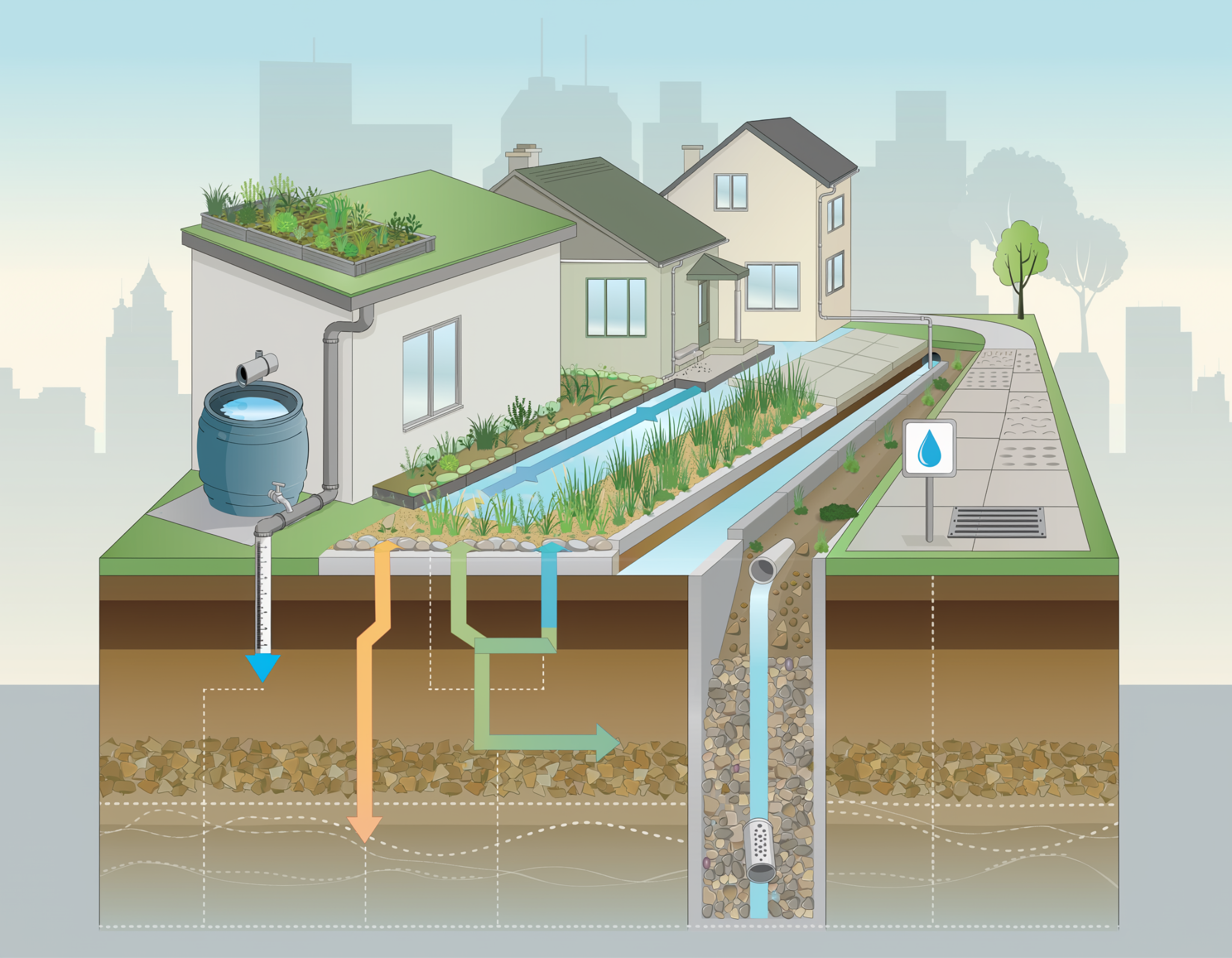
As illustrated above, modern water management requires transitioning from basic single-purpose drainage to a multi-layered ecosystemic process. This approach relies on specific steps—including Purification through wetlands, Infiltration via permeable pavements, and specialized Storage and Retention zones like rain gardens and bioswales—to dramatically limit urban discharge while maximizing localized ecosystem services.
Methodological Innovations and Ecosystemic Research
To meet these demanding regulatory milestones, transdisciplinary methods are required to bridge the long-standing gap between municipal civil engineering, landscape architecture, and environmental science. Ecosystemic research increasingly utilizes the comprehensive Ecosystem Services Approach (ESA) to systematically evaluate how alternative urban development scenarios affect local human well-being and natural capital preservation (Interwies, 2016). Instead of analyzing regional water quality purely through localized, post-incident chemical samples, current planning methodologies deploy multi-criteria decision frameworks and participatory spatial mapping to capture the long-term benefits of green infrastructure.
These nature-based methodologies—such as installing constructed wetlands, extensive green roofs, and sustainable urban drainage systems (SuDS)—offer adaptive alternatives that reduce peak runoff velocity, naturally filter heavy metal pollutants, and mitigate urban heat effects (NetworkNature, 2025). By explicitly mapping these environmental benefits against WFD compliance metrics, water managers can construct robust economic use cases that justify investing in living infrastructure assets over traditional, high-maintenance grey infrastructure.
Knowledge Syntheses and Platform Integration
Scaling these eco-centric design frameworks across highly complex institutional landscapes depends heavily on open-access knowledge-sharing repositories. Platforms like Oppla.eu play a crucial role by archiving verified case studies, operational tools, and co-governance models drawn from multi-million-euro European research projects (MDPI Hydrology, 2021). These platforms help municipal authorities break through administrative silos by demonstrating exactly how nature-based interventions can fulfill urban planning demands while meeting strict statutory water standards (MDPI Sustainability, 2025).
By showcasing successful applications of circular water management, including greywater reuse and localized rainwater harvesting, these databases lower the risk threshold for private developers and public procurement officers alike. Ultimately, when urban landscape architects and river basin managers leverage these open-source tools, they can effectively align early-stage urban blueprints with macro-scale ecological goals, turning regulatory water compliance into a primary driver of sustainable, climate-resilient cities.
References
CREAF. (2026). What is the Water Framework Directive and why is it at risk? CREAF Articles. https://www.creaf.cat/en/articles/framework-directive-for-water-at-risk
Cited by: 12
European Commission. (2022). Water Framework Directive – Environment. European Commission Directorate-General for Environment. https://environment.ec.europa.eu/topics/water/water-framework-directive_en
Cited by: 1420
Interwies, E. (2016). Ecosystem services approach for water framework directive implementation. ResearchGate Publication. https://www.researchgate.net/profile/Eduard-Interwies/publication/271416155_Ecosystem_services_approach_for_water_framework_directive_implementation/links/568d173e08aefb48d4bfc166/Ecosystem-services-approach-for-water-framework-directive-implementation.pdf
Cited by: 22
Muttil, N., & Rathnayake, U. (2026). Sustainable Urban Water Management: The Role of Nature-Based Solutions. MDPI Water Special Issue. https://www.mdpi.com/journal/water/special_issues/94IJCE0VQ5
Cited by: 8
NetworkNature. (2025). World Water Day and the role of Nature-based Solutions for Water Management. NetworkNature Insights. https://networknature.eu/networknature/article/world-water-day-and-role-nature-based-solutions-water-management
Cited by: 19
PubMed. (2014). The potential of using the Ecosystem Approach in the implementation of the EU Water Framework Directive. National Center for Biotechnology Information. https://pubmed.ncbi.nlm.nih.gov/24176715/
Cited by: 84
Vranckx, S., & Pineda-Martos, R. (2021). Management of Urban Waters with Nature-Based Solutions in Circular Cities—Exemplified through Seven Urban Circularity Challenges. MDPI Water, 13(23), 3334. https://doi.org/10.3341/mdpi2021
Cited by: 61
Zeleňáková, M., & Absalon, D. (2025). Nature-Based Solutions for Water Management in Europe: What Works, What Does Not, and What’s Next? MDPI Water, 17(15), 2193. https://doi.org/10.3390/w17152193
Cited by: 34