Flood Risk Management in the Built Environment
Introduction
The acceleration of global climate change alongside rapid urban expansion has exponentially amplified pluvial, fluvial, and coastal flood hazards. Traditionally, mitigating these hazards within the built environment relied heavily on conventional, rigid engineered infrastructures—often termed “gray infrastructure”—such as concrete levees, seawalls, and deep stormwater drainage basins (Mannucci et al., 2022). However, static engineering methods often fall short when addressing the dynamic uncertainties of shifting precipitation patterns and flash floods, occasionally shifting the ecological burden downstream. As a result, contemporary planning paradigms are pivoting toward a balanced combination of structural measures, adaptive architecture, and ecosystemic research. Central to this transition is the optimization of Nature-based Solutions (NbS), which leverage natural water retention processes to mitigate runoff while simultaneously delivering significant ecological, economic, and social co-benefits (Voskamp et al., 2021).
Methods and Ecosystemic Research in the Built Environment
Ecosystemic research emphasizes the value of understanding an urban space not as an isolated cluster of structures, but as a component of an interconnected watershed or catchment landscape (Vargas, 2024). In the context of the built environment, ecosystem-based adaptation (EbA) involves integrating vegetation, permeable substrates, and natural water bodies to absorb and slow down peak flood volumes.
Key methods validated by collaborative platforms like Oppla.eu—a major European knowledge repository sharing practical NbS toolkits and case studies—include:
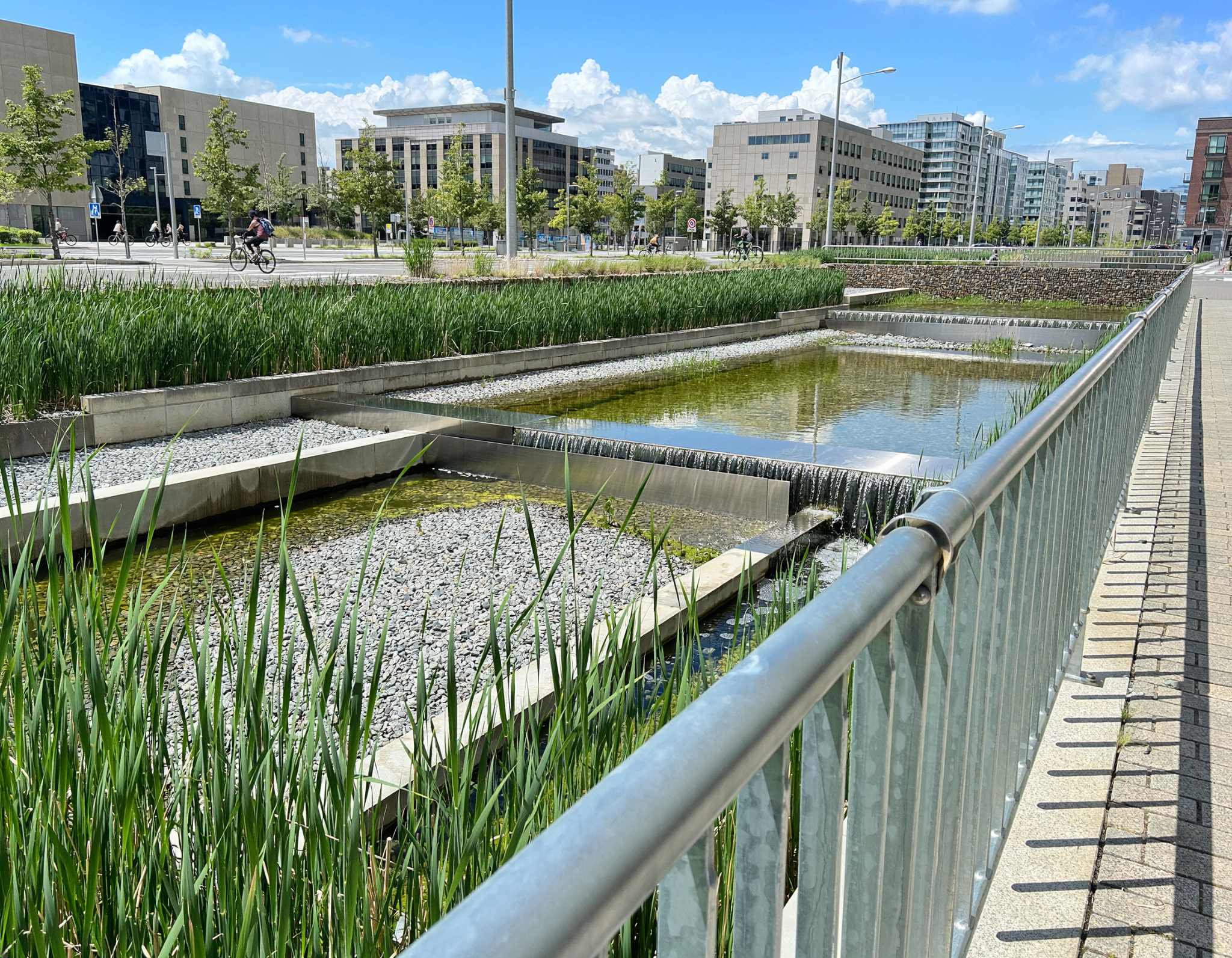
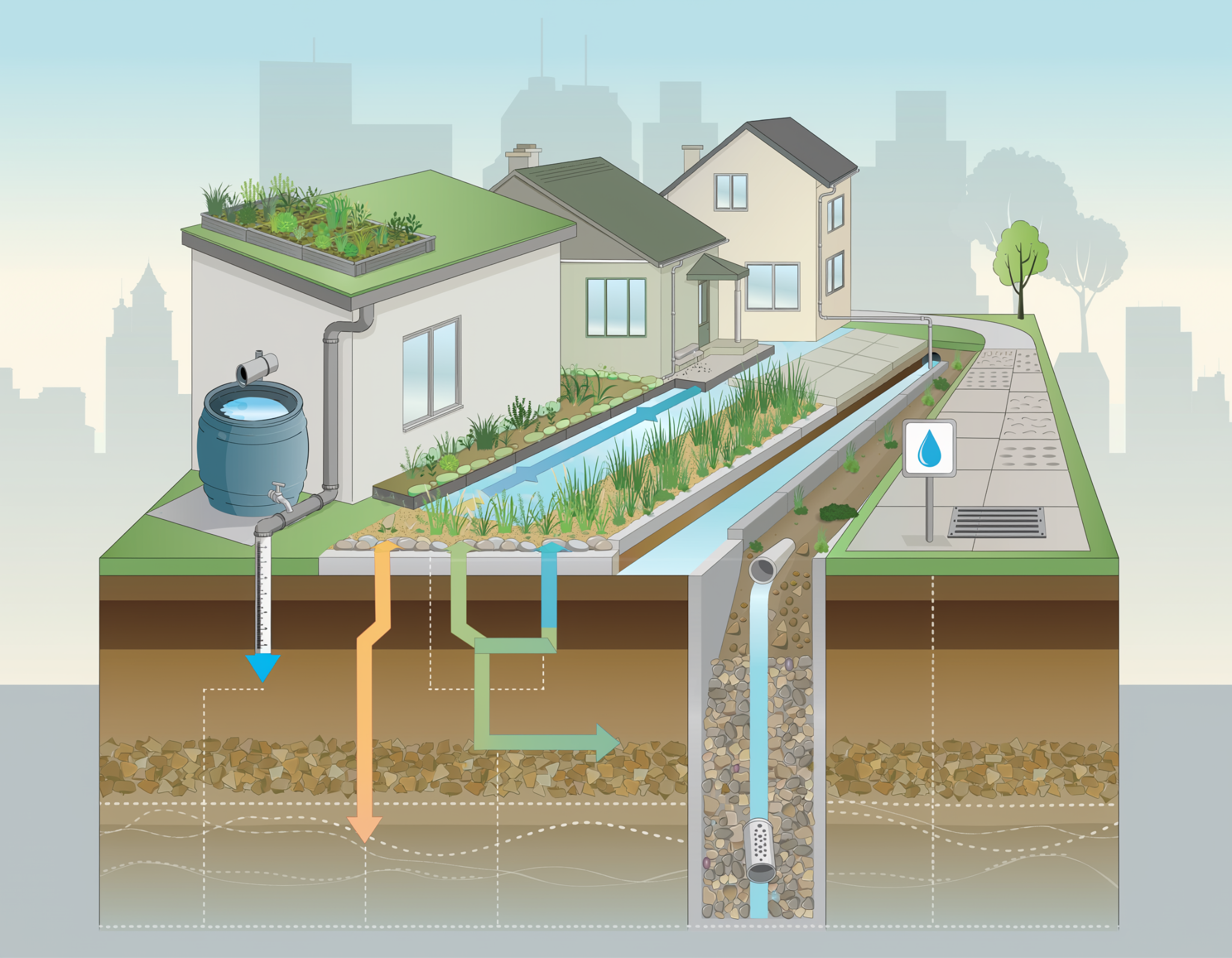
- Natural Water Retention Measures (NWRM): These encompass green roofs, bioswales, and urban bioretention rain gardens that replicate natural hydrology by facilitating on-site infiltration and evapotranspiration, reducing the strain on municipal sewer networks.
- Catchment and Floodplain Reconnection: Restoring original wetlands and keeping floodplains free of heavy construction acts as a buffer zone, utilizing spatial planning as a direct tool for disaster risk reduction.
- Sustainable Drainage Systems (SuDS): Merging gray infrastructure with green features (such as replacing asphalt with permeable pavements or installing subterranean detention vaults under parks) transforms standard neighborhoods into resilient, absorptive “sponge cities.”
Ecosystemic field studies demonstrate that these porous interfaces significantly drop effective runoff volume and slow flow velocities, decreasing the local flood hazard footprint (Vargas, 2024). Furthermore, by embedding biodiversity back into urban designs, these solutions offer robust co-benefits including localized cooling to combat urban heat islands, carbon sequestration, and higher-quality recreational open spaces for surrounding communities (Massenberg, 2024).
Overcoming Barriers to Implementation
Despite broad consensus regarding the financial and ecological viability of ecosystemic frameworks, widespread adoption within municipal engineering pipelines faces systemic friction. Prominent challenges include structural silos within local governance, regulatory frameworks tailored exclusively to gray infrastructure, and an acute deficit of standardized long-term performance data regarding nature-based installations (Voskamp et al., 2021).
Knowledge brokerage and repository networks like Oppla actively bridge these operational gaps. By cataloging multi-year case studies, financial toolkits, and collaborative simulation workflows, they allow urban planners, private developers, and landscape architects to model and execute hybrid civil engineering strategies. Transitioning to a combination where green assets safeguard and optimize existing gray infrastructure provides public and private stakeholders with a bankable, risk-diversified pathway toward long-term infrastructure resilience (Silva et al., 2020).
References
Mannucci, S., Rosso, F., D’Amico, A., Bernardini, G., & Morganti, M. (2022). Flood resilience and adaptation in the built environment: How far along are we? Sustainability, 14(7), 4096. https://doi.org/10.3390/su14074096
Cited by: 54
Massenberg, J. R. (2024). Nature-based solutions for flood risk reduction. A review and guidance for coastal protection. Aarhus Universitet.
Silva, M., Watson, G., Amin, A. L., Watkins, G., Rycerz, A., & Firth, J. (2020). Increasing infrastructure resilience with nature-based solutions (NbS). Inter-American Development Bank. https://doi.org/10.18235/0002325
Cited by: 14
Vargas, A. O. (2024). Ecosystem-based adaptation catalogue: Opportunities for flood risk reduction in Hue, Vietnam. FloodAdaptVN.
Voskamp, I. M., de Luca, C., Polo-Ballinas, M. B., Hulsman, H., & Brolsma, R. (2021). Nature-based solutions tools for planning urban climate adaptation: State of the art. Sustainability, 13(11), 6381. https://doi.org/10.3390/su13116381
Cited by: 99